
“Dawn of the Augur” (Single) — Official Liner Notes


“Dawn of the Augur” (alt. title “The Crossing of Auspices”) dropped on 01/22/2026. Listen wherever you get your music. These Liner Notes serve to supplement the release, providing the lyrics, colophon, and credits, as well as broader insights into the context, construction, and meaning of the track directly from the creator. This follows the trend of my previous single, which you can read more about in the “hapless romantics” notes. If you haven’t already, listen to the new track and feel free to drop a reply if you took something from the song and/or post!
Background:
The whole journey of independently writing, recording, and producing the finished track started on January 13th, becoming my world for about a week-and-a-half of maybe ~50 hours of intensive, borderline-obsessive effort and roughly 60Gb of wasted .wav recordings. Taking into account the proportion of work and digital material with the result (3:28 minutes of audio and a 60mb file) always reminds me that creation can be, relatively speaking, an immensely destructive (albeit meaningful) process. Moreover, being between jobs, and frankly, in the literal and figurative winter of my discontent, set the conditions for me to enter a flow state and accomplish new work, something which might seem at odds with regular routines and relationships, but which to me, act as an essential pressure for when the passion calls. Despite the imbalance, I am thankful to have answered that call, satisfied and rewarded with the finished product, as it carries a new form of expression—a tattoo of the time it was made—to be heard by anyone with a set of speakers or headphones!
Songwriting:
First came the beat. The main looping acoustic guitar progression that you hear throughout is a finger-picking melody (one guitar, recorded stereophonically) that had been roosting in my iPhone memo demos from February 3rd, 2024, under the temporary title, “Modern Sports in Medieval Times.”
Up until recently, I hadn’t found a good direction to take it. When I started recording, that was the first part I tracked, in addition to an audio sample from a Brewers game I attended earlier last summer (the applause you hear in the intro, recycled later on as the claps in the end), tying into the original title. From there, the rest of the instrumental (which is coupled with the single as its own version), drum beat, bass guitar, piano, ukulele, synths, and electric guitar riffs came together. Midway through the process, I decided I wanted to record the piano part on a real piano. Incidentally, I was travelling back home to see family, and our friends Dan Libman and Molly McNett (who host the annual Beercat Festival), let me play on their Wm. Knabe & Co. grand for an hour before the fateful Bears vs. Rams playoffs game on the 18th. Bears lost, but the analogue ivory really shaped up nice in the mix!
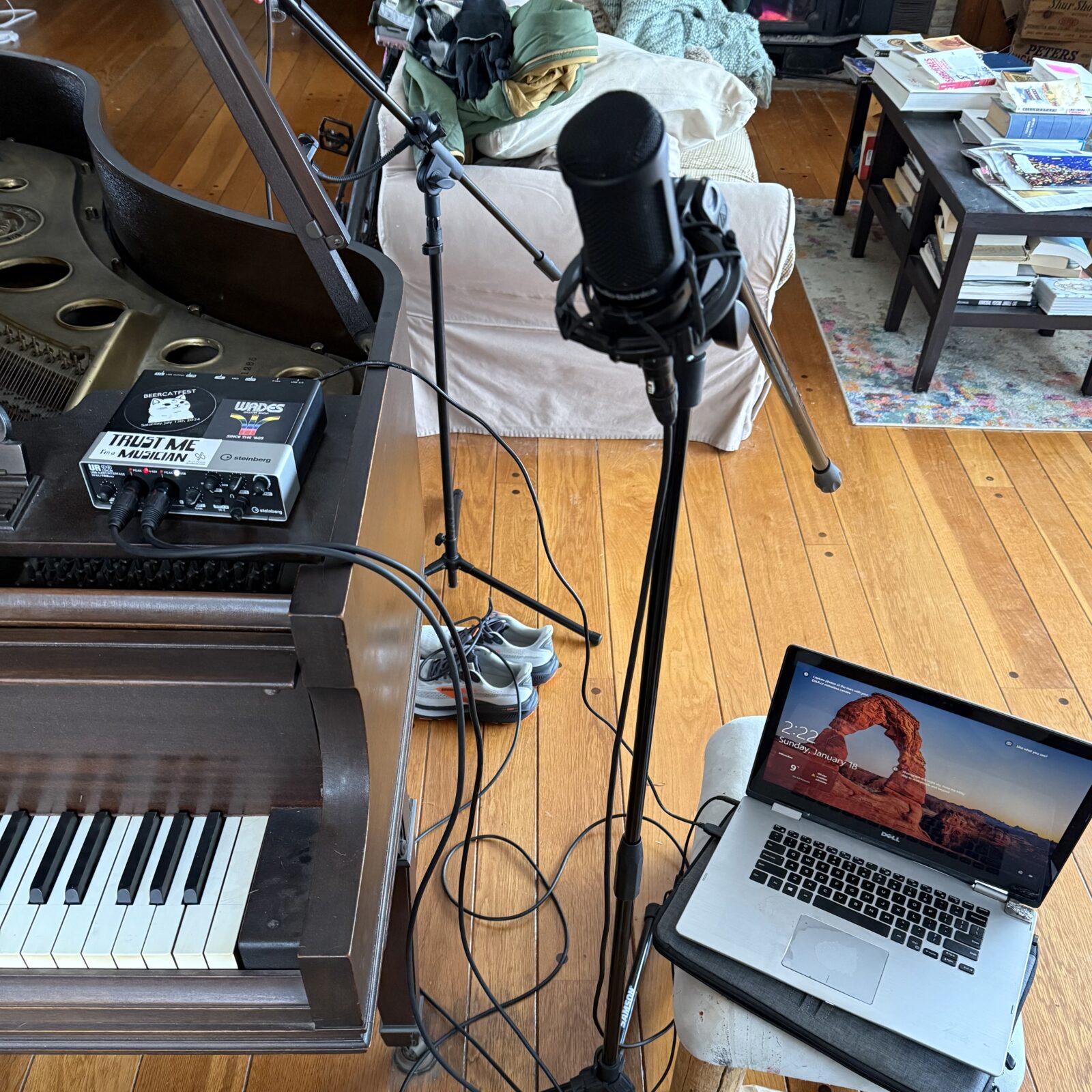
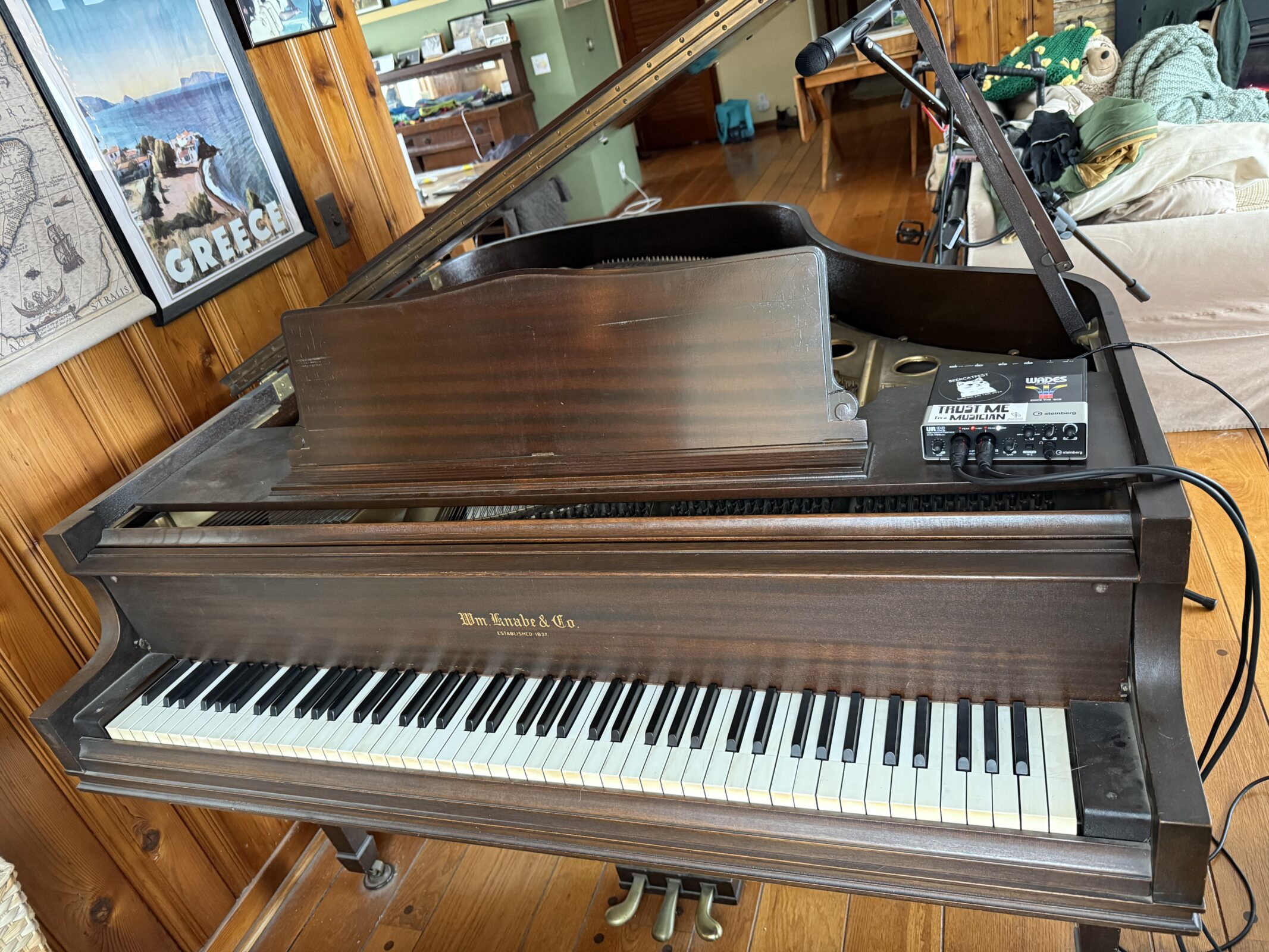
The arrangement occupied a lot of the production work; I spent much of the time listening to the harmonies and deciding which parts would fit and where. The piano and ukulele have a cool interaction in the treble, complimenting each other to make that percussive, twinkly sound. There’s also a really badass resonant harmonic sprouting from the main acoustic riff. If you listen very closely, you can hear a natural high F# ringing out, something I first noticed mixing in headphones, which inspired some of the upper embellishments in the synth parts.
Then came the clarinet. I hadn’t played much on my Buffet Bb since high school, but pressing my fingers over the tone holes and breathing through it again felt like entering a portal to a bygone world. It was worth voicing those chop-busting woodwind solos to lend a fantastical flavor to the song, though I’d rather not think about how old the reed was.
By a certain point, the beat was starting to sound kind of bardcore. To balance out the medieval-ness, I introduced some electronic elements, synth arpeggios and sweeping pads, which made it feel more like the “modern sports” side of things. I also fiddled with the production, reversing clips and tapping out lo-fi drum samples in the beginning, letting the live kit enter somewhere in the middle and stay till the end. The distorted wah-wah guitar harmonics in the outro did the rest to carry song into the modern age.
The main meter of the song is in 12/8. It’s something I had to figure out after laying down the acoustic part, because it can sound like either 3/4 or 4/4, depending on how you feel it. In my DAW, the project of the tempo is set to 4/4 at 80bpm, which has a similar counting pattern, although in reality, the triplets are what make it 12/8 and feel faster. There is a bridge where the chord progression changes and it sounds like it slows down to 3/4, which is also a trick of the rhythm. I usually don’t take music theory into account when making music, but it applies some significance to this particular song as a whole, so I thought it’d be worth noting.
With the instrumental beat and all the accompaniments in place, I continued by writing the lyrics and vocals.
Lyrics:
Time is a smoking gun
Tickin’ twelve over three
Trill of seven canaries
Tipping off flickers that flock by the ten
I’m setting out there
In this world
My heart dangles on a string
Hung up on a silver lining
To herald the first hint of rain
Congratulations to the bets you made
I know, I know, I know
The sun is cold, yeah
I saw, I saw
The colors of your mind
And damn, they’re divine
Hallelujah to the trick you played
You adhere
To what you want to hear
Crust of a tear
Makes a zest to season the cheer
//
The lyrics unraveled as a formal poem, revolving loosely around the theme of augury, with extra emphasis on the rhythm and cadence. In a close reading of the first stanza, you’ll notice references to numbers. The key is in the syllables. In the first line, “Time is a smoking gun,” the idea of counting is induced with the initial “T” consonant, which anticipates the sound of a syncopated hi-hat several measures ahead. It also employs the idiom “smoking gun,” which means something like “indisputable evidence” in a legal setting, and here, to convey both the inevitable blow of mortality and a sense of urgency. The next line, “Tickin’ twelve over three,” follows through with a fraction of the time metaphor, visualizing a clock ticking with hands pointing to 12 and 3. The six syllables in the line are related numerically to twelve and three: six doubled is twelve, and six halved is three. The quotient of “twelve over three” is four, which are the number of lines in the stanza that it’s ticking down towards, amounting to a feeling of anticipation. That flows into the third line, “Trill of seven canaries,” again, referring the number 7 to the number of syllables, and in concert, revealing the broader theme of augury, or the ancient Greco-Roman practice of divination by watching birds for “auspices,” omens that priests called “augurs” would receive to inform their actions. Hence, the original title, “The Crossing of Auspices,” and the revised title, “Dawn of the Augur.” Make of that what you will!
[A brief note—canaries in the early 20th century were used to warn coal miners if there would be toxic CO2 emissions in the cave1. Left alone in a cage, the birds would stop singing and perish before the miners, indicating lethal conditions. So, there’s a modern sense in which augury survived beyond the classical meaning. “Auspices,” as we’ve come to know today at the root of the word auspicious, generally means something like “occasion for good fortune.” But in this case, a coal-mine canary would be a negative auspice—a fell omen.
Furthermore, I would propose that augury continues as an ever-present practice in our daily lives, not just for ornithologists. After all, in a very ordinary sense, doesn’t the birdsong dawn chorus alert us to what to expect for environmental conditions, the season, forecast, time of day, and so on?]
Digressions aside, canaries in the third line are the subject for “Tipping off flickers that flock by the ten” in the fourth, a total of ten syllables. Flickers is another term for woodpeckers, who tend to flock in smaller groups of five to fifteen. The words flick and flock bring to mind “tick tock,” tying back into time, ending with a slant rhyme: “gun” with “ten”—the fatal blow. On ten, the clarinet comes in at once with a muted-guitar chukka picking-rhythm to depict the flickers taking flight, and also to portray their percussive pecking, respectively…
I want to leave the rest of the lyrics up for interpretation. The reason I thought it would be fun to do this is because not all of the details are obvious on a first or even fifth listen. Consequently, it feels worthwhile to include some clues in these notes. At the same time, it does feel somewhat weird/pedantic to analyze my own lyrics. Oftentimes, myself largely included, many listeners would miss the opportunity to wonder if there’s any critical hidden meaning to a song, and to be fair, for most songs, it’s not always clear, but it’s my hope that maybe sharing a typed-out explanation like this can help start a conversation, either as an internal dialogue within yourself or in a talk with others who listen.

Cover Art:
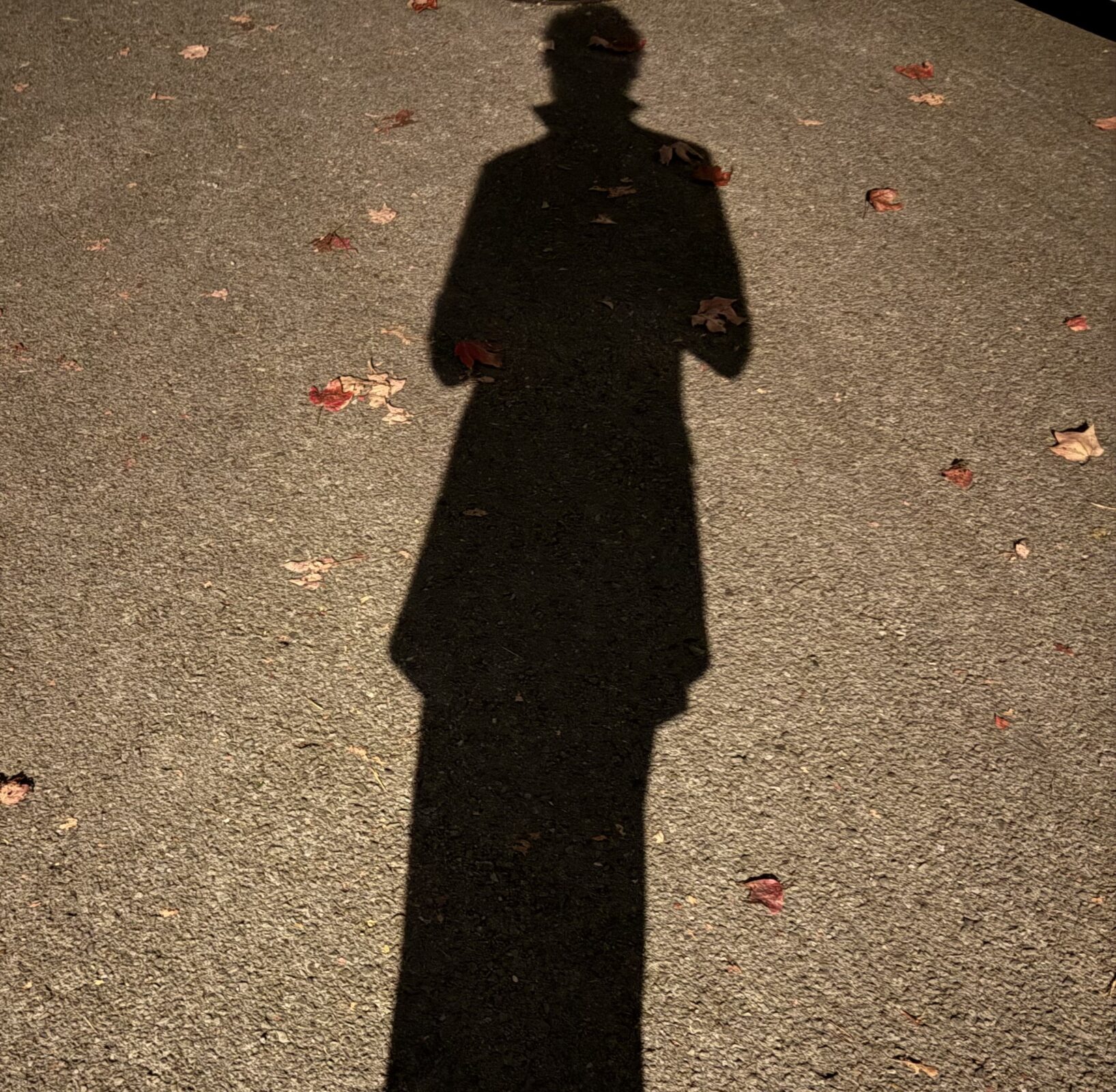
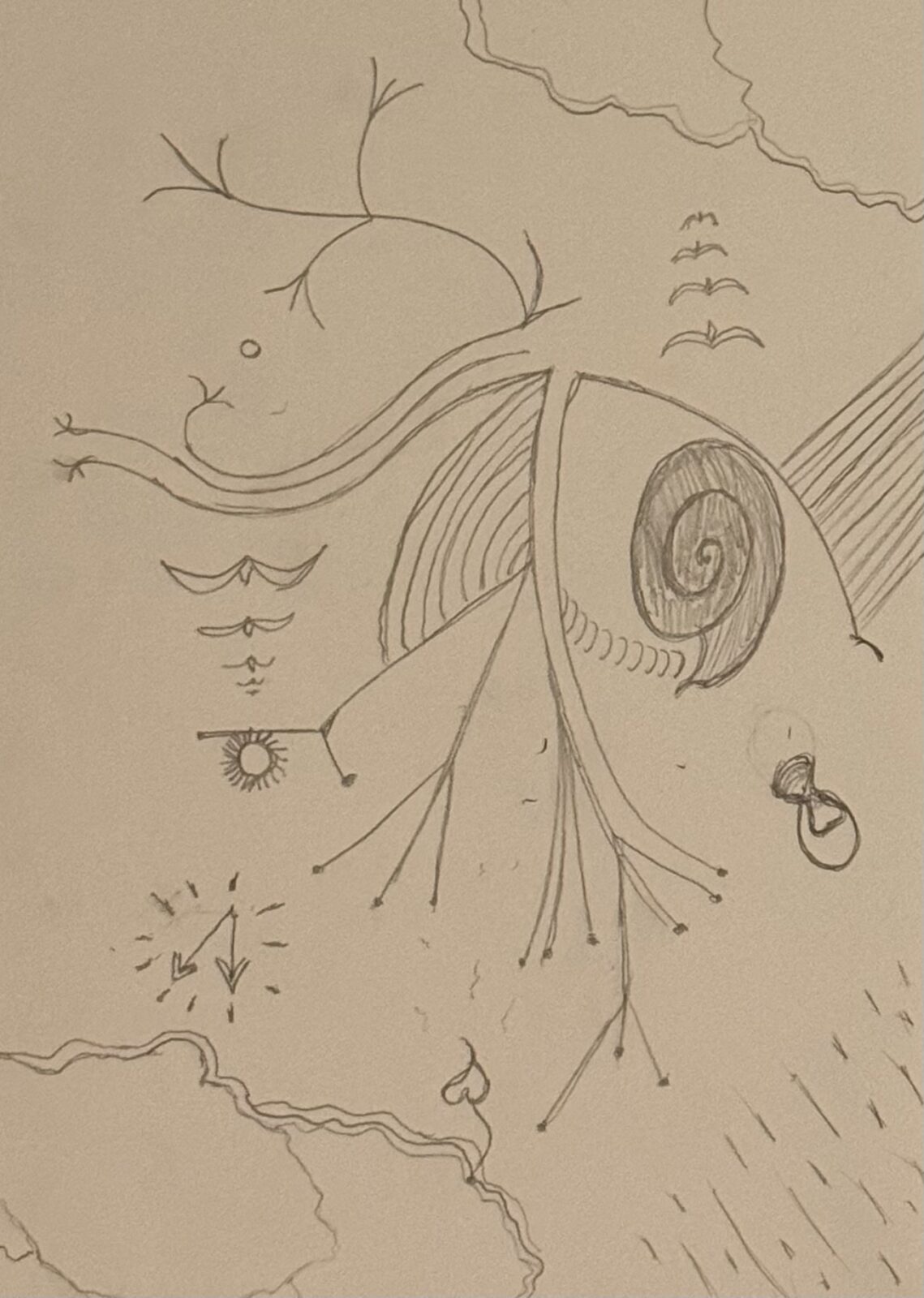
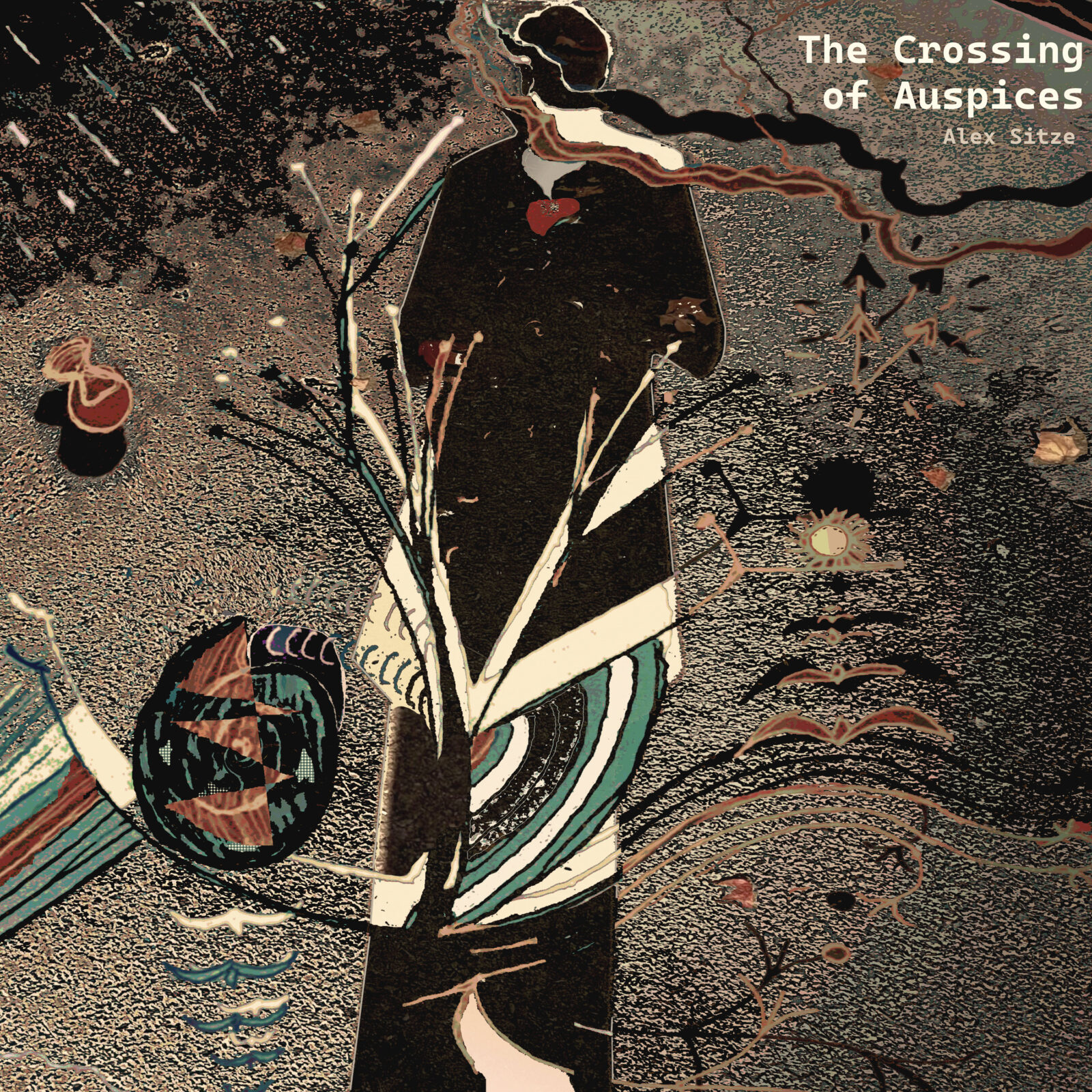
The cover art is composed of a shadow selfie combined with a sketch I drew, overlayed and edited in Paint.NET.
Audio Visualizer:
I put together an official diy audio visualizer to go with the song and theme of augury. The color filters were added in a legacy commercial video-editing program, CyberLink PowerDirector 15. The footage is of (what appear to be) Robins feeding on some berries up close on the window screen of my apartment, which I took sometime last fall.
Credits:
All parts played, written, recorded, mixed, and mastered in 2026 at home in Milwaukee by Alex Sitze.
Colophon:
Instruments used – Bb Clarinet, GarageBand drum samples, acoustic drum kit, trash can, electric guitar, bass guitar, Wm. Knabe & Co grand piano (special thanks to Dan and Molly), dreadnought acoustic, pocket piano GR synth, Harmor, tenor ukulele.
Production – recorded and mixed in FL25. Mastered using Ozone 12.
Footnotes:
Thanks for reading! You can opt in for further blog updates from (In)Sitze by subscribing to the Newsletter below.
Likes