
About My Roundabout Music-Listening MO


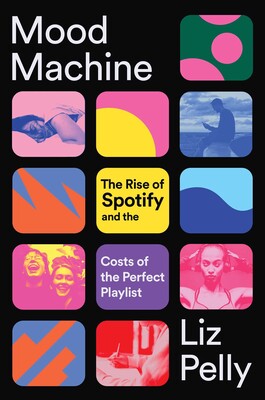
My first blog post on (In)Sitze was over two and a half years ago. I wrote it over a (perennial) family spring break trip to Pensacola, FL, in early 2023, at a time when both my position as a musician and values as a listener were beginning to clash with the state of the industry. I recall wanting to uncover a nagging feeling that my relationship to music listening had atrophied as a result of the conditions set forth by platform capitalism. In particular, my listening habits on Spotify and their focus on marketing massive catalogues of material into miniature personalized feeds. I wondered if these algorithms were an adequate mode to access, and more importantly, appreciate, art, or if there might be other, improved-upon consumer choices for dancing through today’s artistic abundance. Having since gathered some more awareness of the situation from sources like Liz Pelly in her 2025 exposé, “Mood Machine,” and by advocating more ethical online platform practices, i.e., becoming an early adopter/owner of Subvert 🌐, new knowledge sprouted into new outlooks and new habits. These habits are what now comprise my roundabout music-listening modus operandi, which, in addition to being the subject of this post, may be beneficial for others seeking to inform their own approach to music listening in the digital age. As such, this could be deemed a “declaration of reclamation”…
How much is being reclaimed, you might ask? By my estimation, not much—at least in the grand scheme. The workarounds I’ve discovered as a result of my search for a better means of consuming music digitally are relatively limited to the standards I set for myself: niche when compared to the widespread and casual adoption of mainstream apps like Spotify. Indeed, one could say the impact on the world by this topic is trivial, and for the majority of readers, I’d expect there’s not much of a there there. Sure, I could simply drop the whole matter and just use Spotify without a second thought. However, I remain motivated to discuss and share the details because within this idea lies a small touch of subjective success at having independently wriggled out a crag in a flawed yet rigid system—a sidequest in which I sought my own, valid alternative. And indeed, what I have wrought retains many of the same benefits as the original, at the cost of only a few minor conveniences.
First off, I am fully off of Spotify (as a user), refusing to support the platform financially for many of the same reasons artists are choosing to remove their work. I am not off the grid. I switched to Apple Music as a replacement. I paid a small fee for a service called Tune My Music to transfer the Spotify likes/playlists I’d made over the years, shortly before Apple announced their own native transfer tool. Which is a pretty good move on their part, being keen enough to capitalize on the growing frustrations of Spotify’s userbase and their itch to switch to something of greater or equal technological + fiscal value.
For the sake of saving the reader a full-on point-by-point features comparison between Spotify and Apple Music, my simple rundown from the transfer is that they are ~85-90% similar in what they provide—Coke vs. Pepsi. The remaining percentage could be chalked up to some of the social features Spotify offers, like network queues and differing discovery algorithms. But in the end, they may as well be considered apples to Apple. Nevertheless, making the switch is what brought me to the next stage of reclaiming my music-consumption habits. That is, how to set up a worthwhile, personalized discovery “radio” system, one that could rival Spotify’s.
If you spend some time navigating around this site, you’ll notice my Now page. Here, I’ve embedded several disparate feeds from other platforms, calling their API in order to fetch my profile data and display them in automatically refreshing (vibe-coded) HTML widgets. Basically, you can view a bunch of my micro-activities ranging from gaming, reading, movie-watching, and music listening statuses gathered all on one page. In effect, this keeps the page feeling as personal as it does alive.
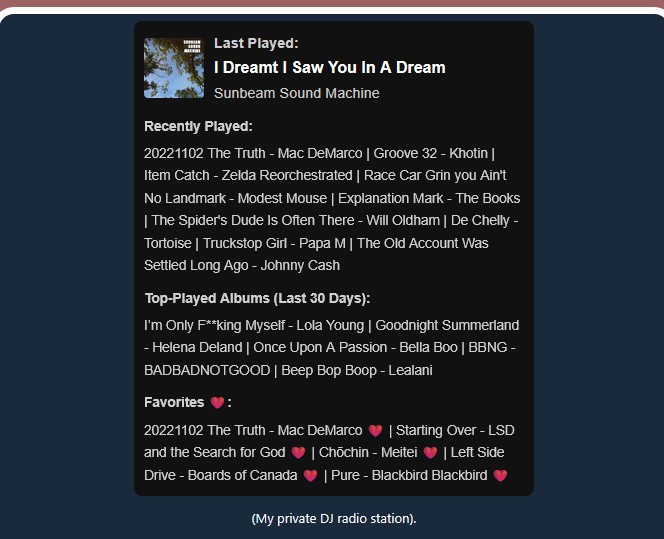
To create the music listening section, I use a freemium service, Last.fm. If you haven’t tried it before, the main function of the site is to build a data map of your, the user’s, listening habits by tracing playback history across platforms, called “scrobbles” (sounds like it could be a British name for aphids). While it isn’t a music player in-itself, over time, Last.fm aggregates the statistics it collects from “scrobbling” and forms recommendations, which can then be played via Spotify or YouTube. These scrobbles can draw from a broad net of sources, expanding the diversity of the recommendations algorithm by scraping data from practically any corner of the internet given it has an audio player and embedded metadata. Additionally, users can then share their stats and connect with other users with similar taste profiles online, lending it a social element. It also allows profile info to be embedded on webpages, like on /now.
To say the least, Last.fm has become a favorite of mine for algorithmic music discovery. What Spotify and many other music-listening apps do in the background with data collection, Last.fm lays out bare and square. Whenever I want a mix of new music, for example, I head over to my Last.fm’s account and check out the recommendations tab. With over 12,000 scrobbles, there is enough information to deliver playlists of wild variety yet tending toward what I like. This makes the process of listening feel rewarding and pure, more like a true discovery. What’s more, choosing YouTube as a player (on a web browser, coupled with AdBlock) makes the selections even sounder. For example, many of the songs are accompanied by music videos, which often take equal effort and vision to produce as the music, provide entertainment value, and occasionally add layers of meaning, yet are typically absent from most regular streaming platforms. Unfortunately, there’s one minor flaw with this digital radio alternative: Apple Music, which I use on my iPhone for 90% of my music listening, doesn’t connect directly to Last.fm.
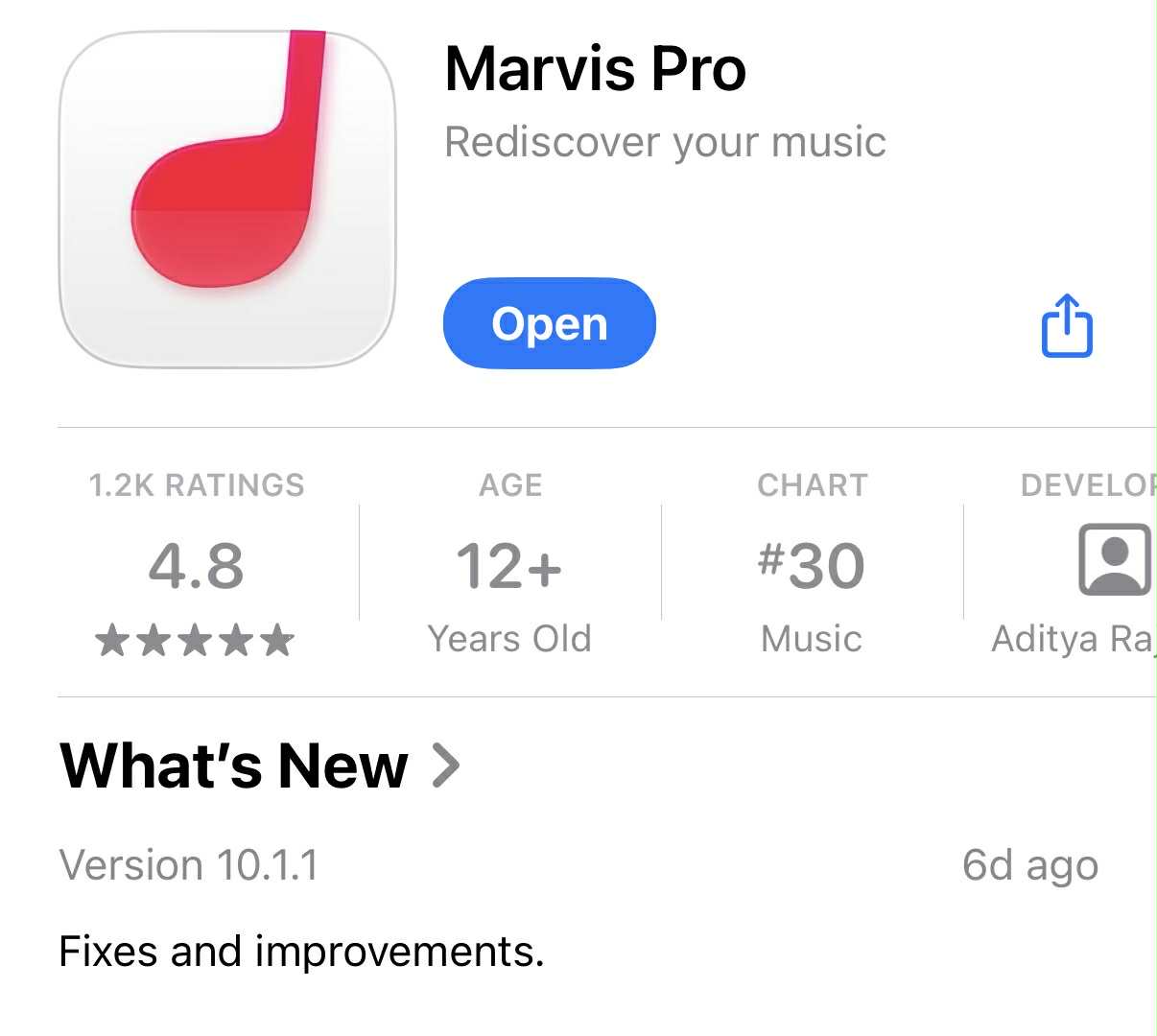
Fortunately, a paid, third-party app called Marvis Pro does. For $10, Marvis allows users to e x p a n d Apple Music’s features into tons of unique configurations, from ultra-customizable aesthetic UI elements down to subtle settings like shaking your phone to shuffle a mix. And, for $5 more, it connects to Last.fm, so whenever I play a song on my phone from either Apple Music’s catalogue or my own downloaded music, Marvis will automatically scrobble it to my Last.fm account, which also updates on my website in real time. This creates an endless feedback loop: the more I listen to music, the more variety it adds to Last.fm, the better and more accurate chance I have at discovering something I’m actually interested in, without paying a pittance to the mood machine. Pretty neat! Very rewarding. Am I shilling? Geeking out? Maybe a bit? Too bad. I think Marvis is great. A little dumb, but great. It serves my purposes well. Needless to say, it has fully replaced the default Apple Music app on my iPhone for the added benefits.
And that’s pretty much the gist: in short, the whole roundabout way I devised to add a tiny bit more friction to my music listening habits and reap the benefits of my personal data heaps at the same time. On the surface, nothing really changed. Arguably, nothing was accomplished. Could I simply not care and use Spotify as normal per intended? Sure. These are not Maslow’s needs (maybe Marvis’ needs). Admittedly, it takes a certain neurotic level of obsession and spare time to pull off an idea like this. But what else could be worth it than the authentic sense of satisfaction? Ultimately, I forged a tiny trail through the thickets, cobbling together several alternatives that combine into a self-wrought solution, a valid “alternative,” aka, an option that exists for someone looking for something different than what’s already present, of greater or equal value. And because this exists, I feel like I’ve manually reclaimed a little of what was lost in the automatic, hidden profit-driven forest behind Spotify’s algorithm, in a way that makes listening to and discovering music in digital formats feel rewarding again. Of course, vinyl and analogue will always take the cake. That said, while my endeavor to find a new MO may be slight, one may relate to the experience of reclaiming something that seemed at one point to disappear from one’s life, yet only required searching for another means to take it back into their own hands.
I invite you to share. Are there any wacky workarounds you have come up with in the effort to regain a feature you miss from a bygone time? Has it lasted through the trials? Let me know in the replies below!
Thanks for reading! You can opt in for further blog updates from (In)Sitze by subscribing to the Newsletter below.