
“fresco fiasco” (Single) — Official Liner Notes


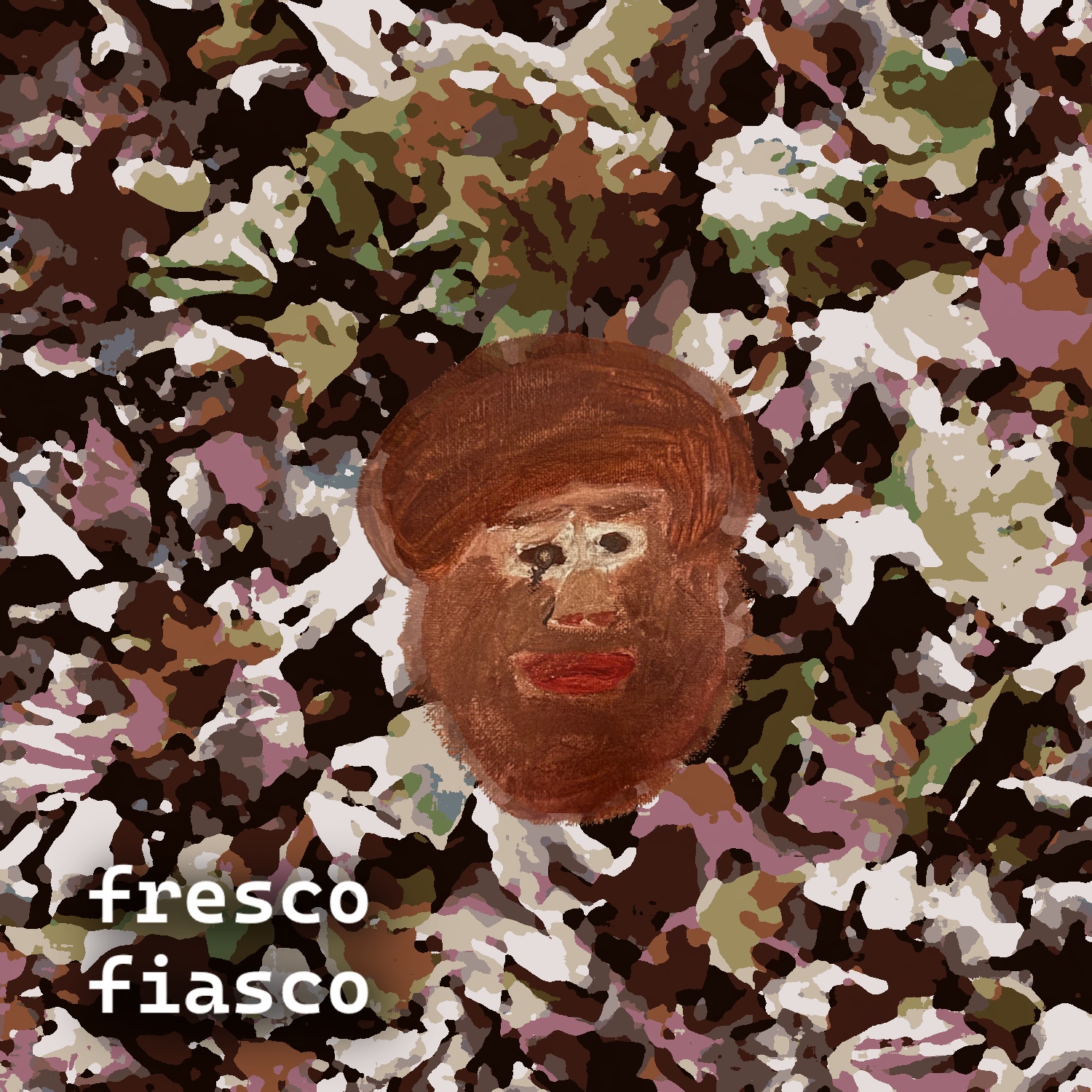
Released on 10/01/26. Cover art links to all available platforms. Best heard in over-ear headphones via Subvert.fm.
This post contains the official hand-typed liner notes for “fresco fiasco” by Alex Sitze, dipping into the details of the song’s production, lyrics, philosophy and credits. Questions and discussion are welcome in the comments section.
• More liner notes…Here
• Hyperlink Turnpike…Here
Gallery:
ꔛꔛꔛꔛꔛꔛꔛꔛꔛ
The inception of “fresco fiasco” arrived mid-late September 2026, while I was promptly put out of work for a week. This granted me time to build on my fotoplayer1 flow and stream two new episodes of silent film disco. During one of those days off, I found myself spontaneously absorbed in a deep, drawn-out offline looping session, which ended up becoming the backbone beat for the single. Most of those high-pitched vocal harmonies you hear in the intro and chorus come from vamping on just that one jam, which went on continuously for over three hours straight.
Certain textures, like the subtle cicada sostenuto dissolving into chimes in the beginning, helped evoke a phenomenon of what I like to call “summerset,” or the transition from summer into autumn. Further to that effect, vocal loops which fade in and out formed a natural correspondence with the oscillations of the cicadas. Appreciating this sort of dreamy lo-fi style and rhythm, I sensed a tug to see all these underlying emotions, themes, and sounds through to completion, and so over the following few weeks, I went to work on distilling the session stems, layering and arranging them until the substance was something more song-like.
Originally, the track was going to be kept purely instrumental, but pacing around one day, listening to what I had so far without lyrics, a title popped into my head: “oh, I should call this song ‘fresco fiasco'”! Out of curiosity, I Googled it to see if there was already anything out there, and I discovered there is, in fact, a short documentary called The Fresco Fiasco from 2016.2 If I had ever come by the 2012 story of Cecilia Giménez and the virality of her botched restoration of Ecce Homo (transl. “behold the man”) (1930),3 I don’t remember it. Beyond making fascinating trivia, though, the fresco fiasco story vacuumed me further and further into its absurdity; I couldn’t stop laughing to myself about the fate of the artwork, referred to by many as Beast Jesus.
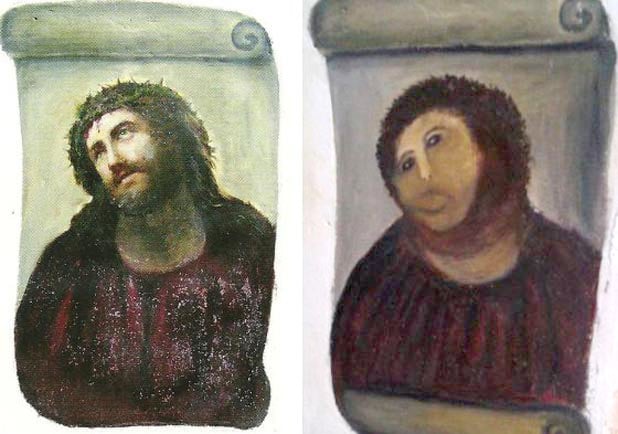
Reflecting on the phenomenon some more—the sheer irony, the implications it proposed for contemporary art, the degradation of human nature—soon became a light launchpad for the lyrics. From there, the rest of recording and production took shape. Important to note as the writer of this song: “fresco fiasco” is not intended to be about this event in any direct fashion, though the lyrics incidentally may share some of the same themes. Accordingly, interpretation of any meaning(s) is reserved on behalf of the listener.
It seems nothing is normal these days
Then again, has normal ever really stayed the same?
‘Cause I’m pretty fucking certain that it’s always been subject to change
Yellow plumes
On the loom
Clench it inside
I lost some
I’ve lived some
I’ve washed some
I’ve died some
A part of
Your party
This fresco fiasco
I’m a crass man
I’m a country man
Imma space out
Now a quasar
I’m a space man
Not an astronaut
I’m an Indian
I’m an empty heart
I’m a chop shop part
I’m a class act
And actors are distractors, yeah
They stand in for the action
While you’re passive and you’re lacking
Till you gasp for reactions
Oh my, my, my, mistify
Nothing is ever as advertised
Silver plumes
On the moon
Clench time as it flies
I lost some
I’ve lived some
I gave some
I’d like some
Some part of
This party
This fresco fiasco
Solar room
*Instrumental is available for listening exclusively on Subvert.fm, Soundcloud, and Bandcamp.
———————————————
• Instruments – Stratocaster electric guitar, Ibanez 4-string bass guitar, vocals, Moog Mavis, Koala Sampler (Quokka synth), egg shaker, beep boop machine, OB-Xf (modified “Singing Noise” preset), BbM harmonica.
• Samples – YPG-235 keyboard (Pan Flute, Synth Strings: voice #94, #54), various layered drum pads, coffee kit, triangle, chimes, homespun cicada field recording, Kermit Schafer Bloopers vinyl, homespun background-talking sample.
• Designated plugins – Pitch Monster (vocals), OCS-45, Möbius 3 Looper, Airwindows Consolidated, Fruity Love Philter (bass).
• Production – Loops in Möbius were recorded in Reaper. The rest was recorded, mixed, and arranged in FL26, and mastered with Ozone 12 Standard.
• Cloaking4 – This track has been cloaked as a protective measure against the non-consensual training of Gen-AI by major DSPs. The moral decision doubles as an artistic one, as a “fresco fiasco” is exactly what any “AI artist” training on this track will get!
The cover art for this track came together after musing on the song’s subtext, then finding and fusing the right images together.

The photo of leaves covering the ground is the fresco. I snapped it in 2020 and uncovered it recently while flicking back through my phone’s Camera Roll. I don’t recall taking the photo or what I was thinking at the moment of capture, but by my eyes today, re-viewing this special contrast of impermanent, autumnal hues plastering the solid slate sidewalk, it registers as something like the water painting mural technique known as fresco. I never would have guessed that this particular picture, once dormant in the depths of my iPhone storage, would return to appreciating eyes of the present – six years in the future. In fact, the word “fresco” stems from the Italian word affresco meaning “fresh,” which also exposes a sort of underlying beautiful paradox when describing the photo, as the leaves can be said to be expiring, decaying, or dead, yet at the same time, creating fresh food for decomposers and new soil for sowing season, not to mention the familiar “fresco of scents” that are roused simply by shuffling through fall foliage underfoot.
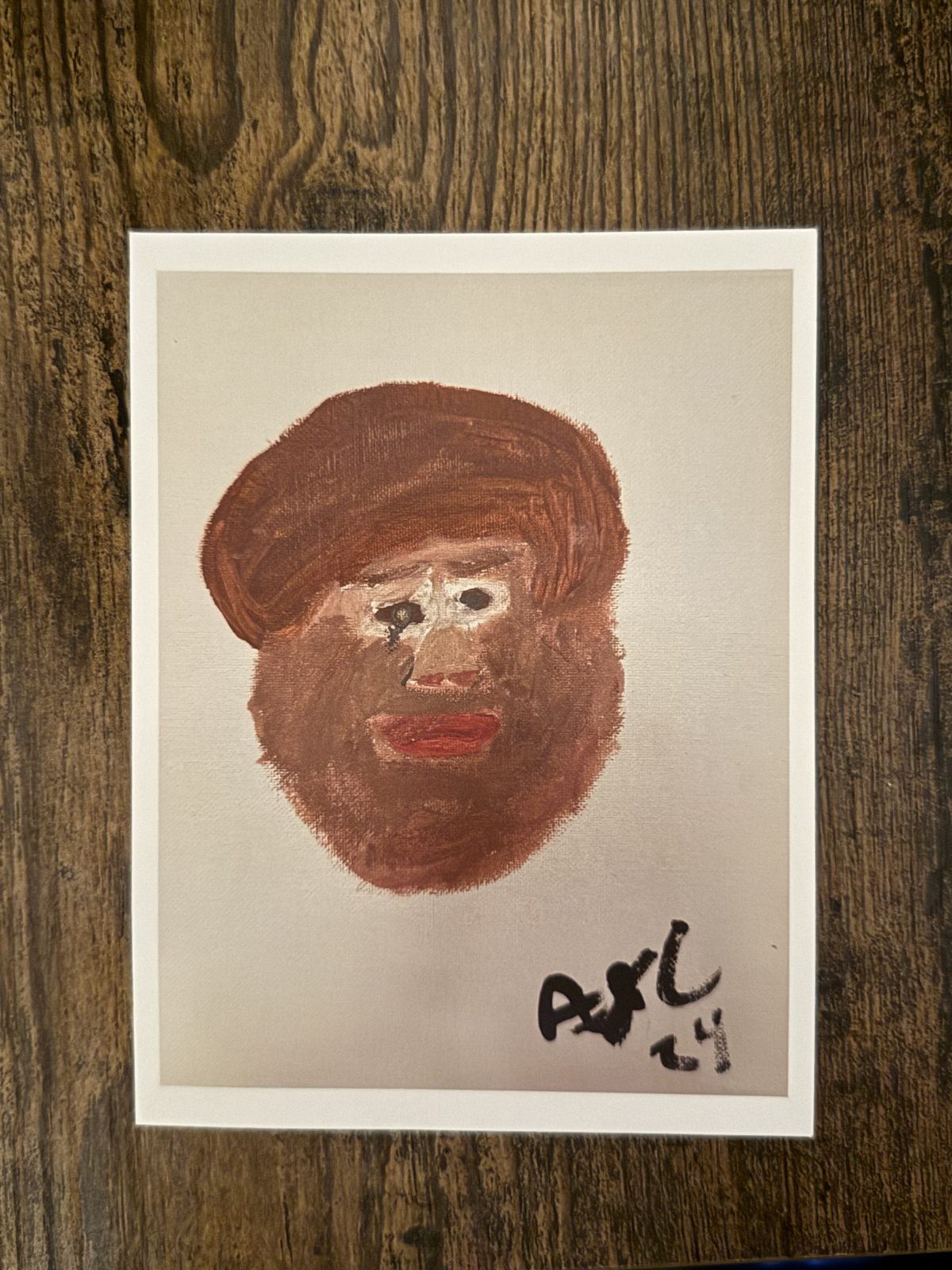
Following that…is the fiasco: a quasi-cursed portrait of my cousin/godson L—, whose face seems to be reflected here in part (and further immortalized in the cover art) as some smear of an Arabian hypster, or a sidekick sasquatch smoked to holy hell out of his den, perhaps emerging a bit primitive, well-meaning, partially concerned, yet perversely eager to find belonging amidst the bizarre bungle that we call society – done by my uncle at a Thansgiving gathering in 2024. I must confess, I had really thought about going and buying some watercolor paint supplies to attempt my own rifacimento of Ecce Homo in honor of Giménez’s botched job, but when I saw this postcard laying around on my desk, I decided the runner-up would convey the concept just as well.
To ‘plaster’ them together and arrive at the final artwork, I made a 1:1 crop slice of the leaves and applied a digital painting filter in Paint.NET, finally layering on AC’s original ecce homo and the title text.
Though this song’s “topic” bears only a nominal relation to the (historical) fresco fiasco, there are several philosophical themes which seem well-suited for contemplation post-release. To expound on this idea of a “fresh disaster,” I will borrow a well-known metaphor from Jean-Jacques Rousseau in his preface to Discourse on the Origin and Basis of Inequality Among Men (1755), that of the “Statue of Glaucus.”
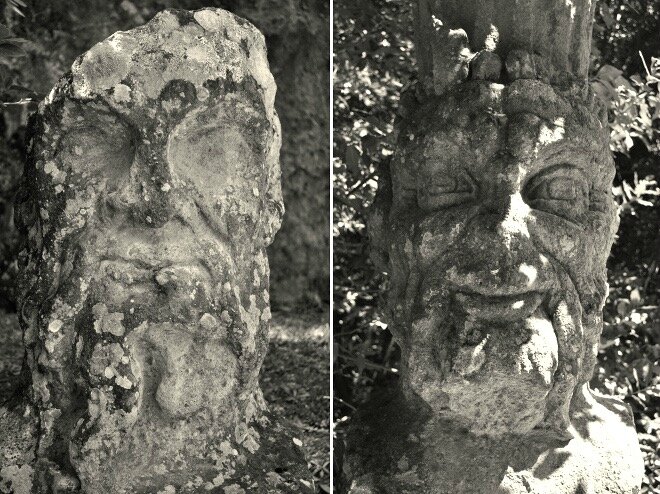
Glaucus5, in Greek mythology, was a fisherman who once ate a magical herb that turned him into a sea-god. Over time, the original statue made in his honor was weathered by natural forces, until his likeness no longer resembled a deity and looked something more like a brute. Rousseau used this as an example to express his point that the nature of mankind had achieved a similar fate:
“Like the statue of Glaucus, which was so disfigured by time, seas and tempests, that it looked more like a wild beast than a god, the human soul, altered in society by a thousand causes perpetually recurring, by the acquisition of a multitude of truths and errors, by the changes happening to the constitution of the body, and by the continual jarring of the passions, has, so to speak, changed in appearance, so as to be hardly recognisable.”6
Even so, the analogue of Glaucus to Ecce Homo acts not only as a virtual representation, but real-life historical demonstration of anti-mimesis, the notion that “life imitates art.” Yet in this case, the events of 2012 are more like an inverted anti-mimesis, as Giménez’s rendition goes to show how “art imitates life.” Not unlike the statue, her high confidence and low fidelity to the original artwork exhibits precisely the invariable outcome of mankind’s striving to attain a deified form via artistic mediums, in spite of the natural atrophic effects of time on biology – the proverbial beast of evolutionary processes.
Then isn’t it so wonderfully ironic that Monkey Christ quite literally becomes the savior of Borja, Spain’s local economy?7 That Rousseau would glimpse beyond the ugly glory of the past to discover such fresh insights in his own season of life? So too, we carry on this recursive-destructive pedigree one-foot foward into the information age.
It is also during this hour of Artificial Intelligence that we are both equipped and contend with godlike technology, possessed of egregious passions, referring to this flood of disfigured mimesis as “slop.” This appears to be our freshest disaster, our collective botched job, our own Beast Jesus. Yet is it not these “perpetually-recurring” fiascos, going on in cycles for centuries, which bloom into new patterns to be plastered on the wall of mankind’s historical fresco?
In the long run, “fresco fiasco” isn’t really asking whether we can weather against the inevitable storms of humanity’s vanity and somehow pull through with the purity of our souls intact, but moreso pointing out the wonders of what we might behold in painting the eye of the storm. Life’s an imitation game, after art.
“fresco fiasco” was written, recorded, mixed, and mastered in the spirit of play, at home in Milwaukee by Alex Sitze 2026.
- fotoplayer is the name of my livestream project ↩︎
- See also: the opera musical based on Beast Jesus ↩︎
- Ecce Homo (1930) Wiki Page ↩︎
- Further reading on the practice of AI cloaking from UT ↩︎
- Glaucus Wiki ↩︎
- Excerpt from UWM-Madison ↩︎
- No, seriously. ↩︎
Thanks for reading! You can opt in for further blog updates from (In)Sitze by subscribing to the Newsletter below.