
“fresco fiasco” (Single) — Official Liner Notes


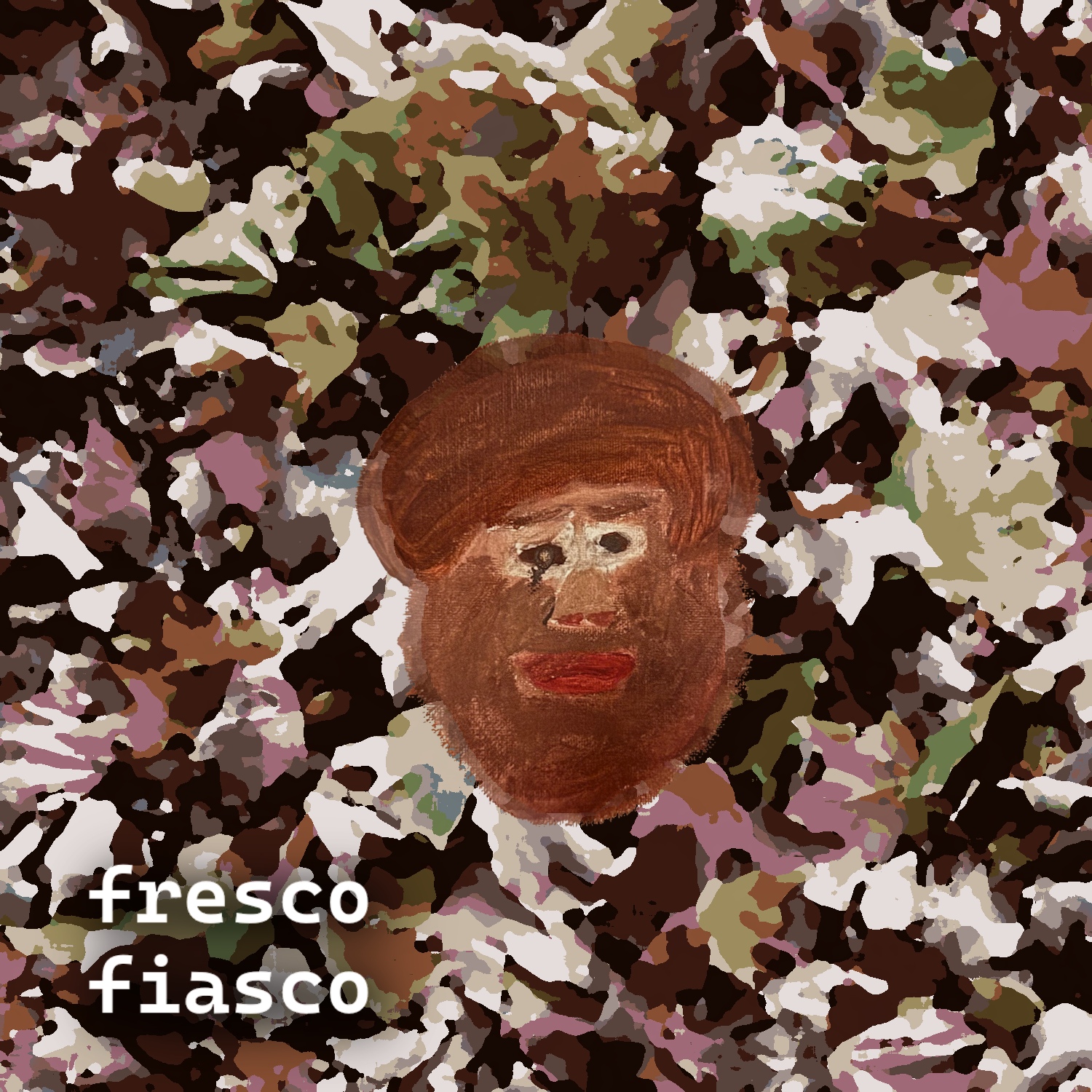
Released on 10/01/26. Cover art links to all available platforms. Best heard in over-ear headphones via Subvert.fm.
This post contains the official hand-typed liner notes for “fresco fiasco” by Alex Sitze, dipping into the details of the song’s production, lyrics, philosophy and credits. Questions and discussion are welcome in the comments section.
• More liner notes…Here
• Hyperlink Turnpike…Here
Gallery:
ꔛꔛꔛꔛꔛꔛꔛꔛꔛ
Writing “fresco fiasco” began mid-late September 2026, while I was promptly put out of work for a week. This granted me time to build on my fotoplayer1 flow and stream two new episodes of silent film disco. During one of those days off (the 12th), I found myself spontaneously absorbed in a deep, drawn-out offline looping session, which ended up becoming the backbone beat for the single. Most of those high-pitched vocal harmonies you hear in the intro and chorus come from vamping on just that one jam, which went on continuously for over three hours straight.
Certain textures, like the subtle cicada sostenuto dissolving into chimes in the beginning, helped evoke a phenomenon of what I like to call “summerset,” or the transition from summer into autumn. Further to that effect, vocal loops which fade in and out formed a natural correspondence with the oscillations of the cicadas. Appreciating this sort of dreamy lo-fi style and rhythm, and sensing a tug to see all these underlying emotions, themes, and sounds through to completion, over the following few weeks, I went to work on distilling the session stems, layering and arranging them until the substance was something more song-like.
Originally, the track was going to be kept purely instrumental, but pacing around one day, listening to what I had so far without lyrics, a title popped into my head: “oh, I should call this song ‘fresco fiasco'”! Out of curiosity, I Googled to see if anything by that name was already out there, and I discovered there is, in fact, a short TV documentary called The Fresco Fiasco from 2016.2 If I had ever come by the 2012 story of Cecilia Giménez and the virality of her botched restoration of Ecce Homo (transl. “behold the man”) (1930),3 I don’t remember it. Beyond making fascinating crumbs for trivia, however, the fresco fiasco vacuumed me yet further into its lore and sacrilegious absurdity; seeing “Beast Jesus” through virgin eyes and thinking about the fate of the artwork nearly brought me to tears of laughter.
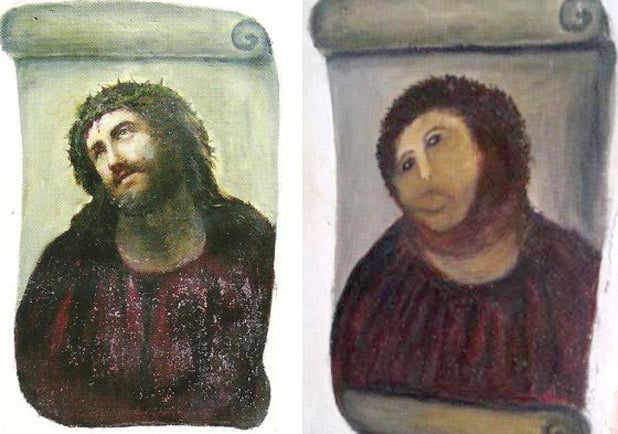
Reflecting on the phenomenon some more—the sheer irony of iterative mockery, the implications it proposed for contemporary art, the degradation of human nature—soon became a light launchpad for the lyrics. From there, the rest of recording and production took shape.
Note from the writer: “fresco fiasco” is not intended to be about this event in any direct fashion, though the lyrics incidentally may share some of the same themes. Accordingly, interpretation of any meaning(s) is reserved on behalf of the listener.
It seems nothing is normal these days
Then again, has normal ever really stayed the same?
‘Cause I’m pretty fucking certain that it’s always been subject to change
Yellow plumes
On the loom
Clench it inside
I lost some
I’ve lived some
I’ve washed some
I’ve died some
A part of
Your party
A fresco fiasco
I’m a crass man
I’m a country man
Imma space out
Now a quasar
I’m a space man
Not an astronaut
I’m an Indian
I’m an empty heart
I’m a chop shop part
I’m a class act
And actors are distractors, yeah
They stand in for the action
While you’re passive and you’re lacking
Till you gasp for reactions
Oh my, my, my, mistify
Nothing is ever as advertised
Silver plumes
On the moon
Clench time as it flies
I lost some
I’ve lived some
I gave some
I’d like some
Some part of
This party
This fresco fiasco
Solar room
*Instrumental is available for listening exclusively on Subvert.fm, Soundcloud, and Bandcamp.
———————————————
• Instruments – Stratocaster electric guitar, Ibanez 4-string bass guitar, vocals, Moog Mavis, Koala Sampler (Quokka synth), egg shaker, beep boop machine, OB-Xf (modified “Singing Noise” preset), BbM harmonica.
• Samples – YPG-235 keyboard (Pan Flute, Synth Strings: voice #94, #54), various layered drum pads, coffee kit, triangle, chimes, homespun cicada field recording, Kermit Schafer Bloopers vinyl, homespun background-talking sample.
• Designated plugins – Pitch Monster (vocals), OCS-45, Möbius 3 Looper, Airwindows Consolidated, Fruity Love Philter (bass).
• Production – Loops in Möbius were recorded in Reaper. The rest was recorded, mixed, and arranged in FL26, and mastered with Ozone 12 Standard.
• (some) (musical) influences – The Halo Benders, Joey Pecoraro, M83, Modest Mouse, Ween, Toro y Moi, King Kong
• Cloaking4 – This track has been cloaked on streaming services as a protective measure against the non-consensual training of Gen-AI by major DSPs. *This was primarily an artistic choice (before a moral one), as a “fresco fiasco” is exactly what any “AI artist” training on this audio will get!
The cover art for this track came together after musing on the song’s subtext, then finding and fusing two related/unrelated images.

The photo of leaves covering the ground is the fresco. I snapped it in 2020 and uncovered it recently while flicking back through my phone’s Camera Roll. I don’t recall taking the photo or what I was thinking at the moment of capture, but by my eyes today, re-viewing this special contrast of impermanent, autumnal hues plastering the solid slate sidewalk, it registers as something like the water-painting mural technique known as fresco. I never would have guessed that this particular picture, once dormant in the depths of my iPhone storage, would return to appreciating eyes of the present – six years in the future. In fact, the word “fresco” stems from the Italian word affresco meaning “fresh,” which also exposes a sort of underlying beautiful paradox when describing the photo, as the leaves can be said to be expiring, decaying, or dead, yet at the same time, creating fresh food for decomposers and new soil for sowing season, let alone a familiar “fresco of earthly scents” that are roused simply by shuffling through fall foliage underfoot.
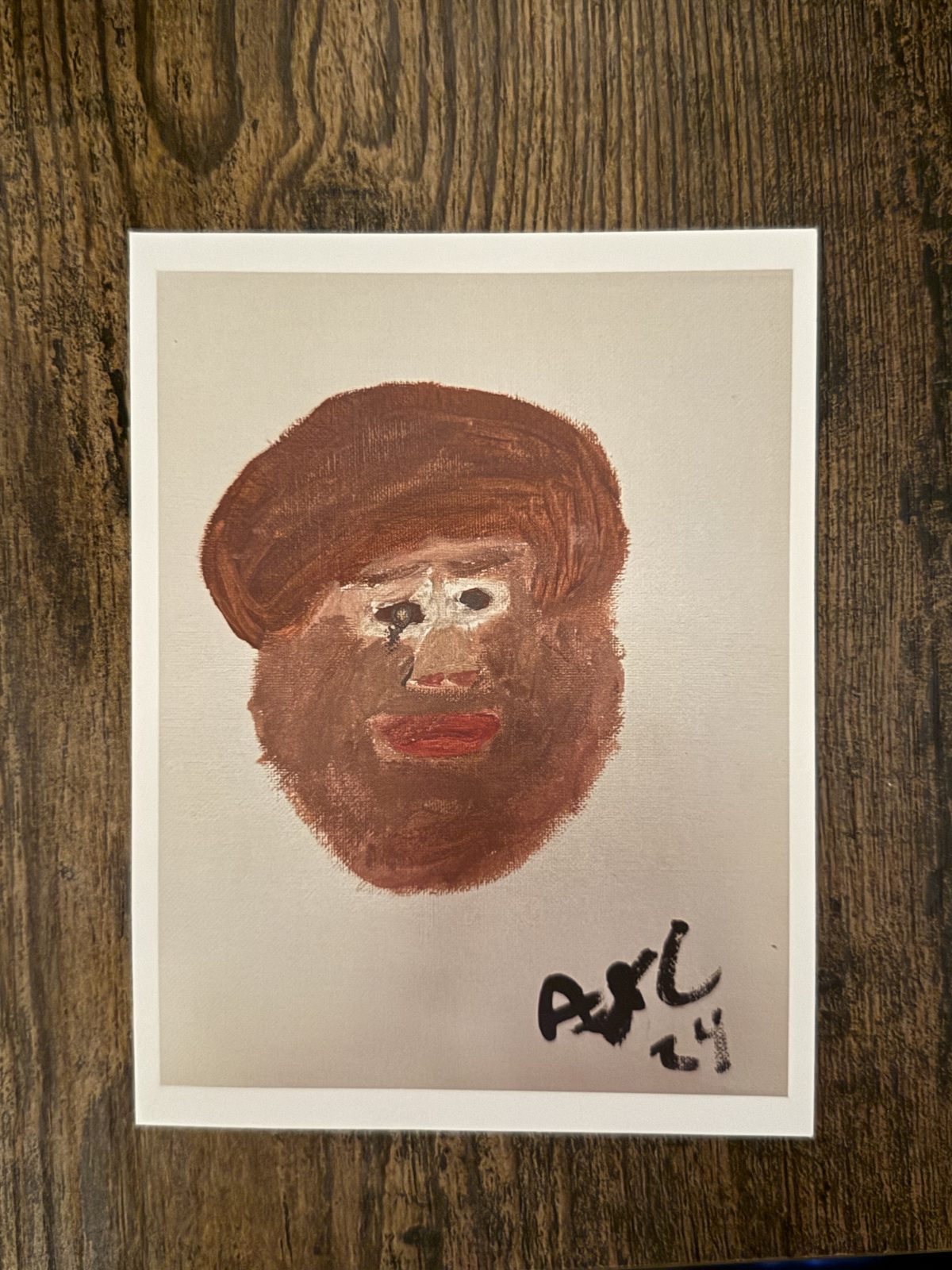
Following that…is the fiasco: a quasi-cursed portrait of my cousin/godson L—, whose face seems to be reflected here in part (and further immortalized in the cover art) as some smear of an Arabian hypster, or a sidekick sasquatch smoked to holy hell out of his den, perhaps emerging a bit primitive, well-meaning, partially concerned, yet perversely eager to find belonging amidst the bizarre bungle that we call society – done by my uncle at a Thansgiving gathering in 2024. I must confess, I had considered going out and buying some watercolor paint supplies to attempt my own amateur rifacimento of Giménez’s artistic blunder, but when I saw this postcard laying around on my desk, I decided the runner-up would convey the concept just as well.
To ‘plaster’ them together and arrive at the final artwork, I made a 1:1 crop slice of the leaves and applied a digital painting filter in Paint.NET, finally layering on Cozzi’s original ecce homo and the title text.
Though this song’s “topic” bears only a nominal relation to the (historical) fresco fiasco, there are several philosophical themes which seem apt for contemplation post-release. To expound on this idea of a “fresh disaster,” I will borrow a well-known allegory from Jean-Jacques Rousseau, originally described in his preface to Discourse on the Origin and Basis of Inequality Among Men (1755), that of the “Statue of Glaucus.”
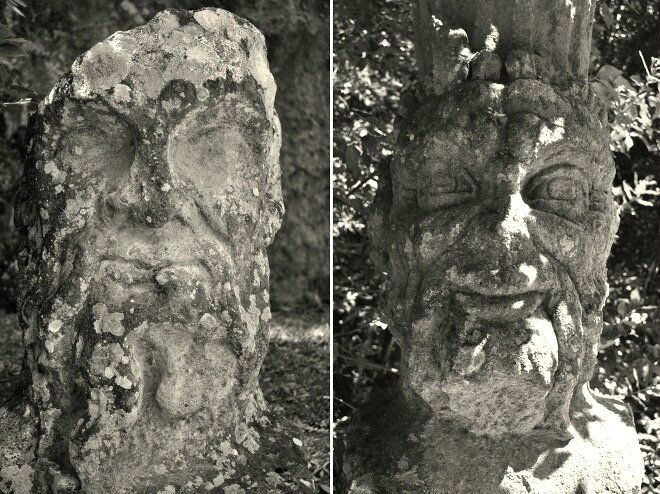
Glaucus5, from Greek mythology, was a fisherman who once ate a magical herb that turned him into a sea-god. Over time, the statue formed in his honor became weathered by natural forces, until his likeness no longer resembled a deity and appeared more like a brute. Rousseau used this parable to draw a parallel to the moldering shape of human nature:
“Like the statue of Glaucus, which was so disfigured by time, seas and tempests, that it looked more like a wild beast than a god, the human soul, altered in society by a thousand causes perpetually recurring, by the acquisition of a multitude of truths and errors, by the changes happening to the constitution of the body, and by the continual jarring of the passions, has, so to speak, changed in appearance, so as to be hardly recognisable.”6
Even so, the analogue of Glaucus to Ecce Homo acts not only as a virtual representation, but a real-life historical demonstration of anti-mimesis, the notion that “life imitates art.” Though in this case, the events of 2012 are more like an inverted anti-mimesis, as Giménez’s rendition exhibits a work wherein “art imitates life.” Not unlike the statue, the (Spain)ter’s high confidence and low fidelity to the original artwork signifies the invariable outcome of Homo sapiens’ striving to conserve a semblance of deification via artistic representation, in spite of the natural atrophic effects of time on corporeal canvases – the proverbial Beast of evolutionary processes.
Then isn’t it so wonderfully ironic that Monkey Christ quite literally becomes the savior of Borja, Spain’s local economy?7 That Rousseau would have resurrected the tarnished valere of the past to discover such fresh and authentic insights in his own season of life? So too, we carry on this recursive-destructive pedigree one-foot foward here into the uncapitalized age of information.
It is also daunting at this hour of Artificial Intelligence that we are both equipped and contend with godlike technology, possessed of egregious passions, referring to this spate of disfigured mimesis as “slop.” As we continue in the footsteps of borrowed creative energy, this appears to be our freshest disaster, our collective botched job, our own Beast Jesus. Yet is it not these “perpetually recurring” fiascos, going on in cycles for centuries, which bloom into new patterns to be plastered and eventually recognized on the wall of mankind’s historical fresco?
In the long run, “fresco fiasco” isn’t really asking whether we can weather or even wear the inevitable storms of humanity’s crowned vanity and somehow pull through with the purity of our hearts intact, but moreso pointing out the wonders of what we might behold in painting the eye of the storm. It’s a song for vindicating such vanities, and in the same stroke, names a certain feeling: that of continually chasing out-of-reach peaks till they softly collapse in the shallow, ambient valleys of the soul. It’s a song for the fakers, as much as the truthers. Life’s an imitation game, after art.
“fresco fiasco” was written, recorded, mixed, and mastered at home in Milwaukee by Alex Sitze 2026.
- fotoplayer is the name of my livestream project ↩︎
- See also: the opera musical based on Beast Jesus ↩︎
- Ecce Homo (1930) Wiki Page ↩︎
- Further reading on the practice of AI cloaking from UT ↩︎
- Glaucus Wiki ↩︎
- Excerpt from UWM-Madison ↩︎
- No, seriously. ↩︎
Thanks for reading! You can opt in to receive posts from (In)Sitze by subscribing to the Newsletter below.